
Marketing communications, commonly abbreviated as marcom, encompasses the strategic use of messaging to promote products, services, and ideas. In today’s media-saturated world, marcom involves a wide variety of tools: advertising, public relations, direct marketing, content creation, digital engagement, and more. But this dynamic and integrated field is the result of centuries of development, shaped by changes in technology, economics, psychology, and communication theory.
Understanding the origins of marketing communications not only offers valuable historical insight but also deepens our appreciation for the strategic thinking that guides contemporary marketing practices.

Ancient Origins: Early Messaging and Trade
The first signs of marketing communication can be traced back thousands of years. Archaeologists have uncovered ancient Egyptian papyrus advertisements dating as far back as 3000 BCE, and painted commercial signs have been found on the walls of Roman ruins. These examples show that even in pre-modern societies, visual and textual persuasion were crucial for facilitating trade and influencing consumer behavior (Jones & Tadajewski, 2011).
However, these early forms were rudimentary. It wasn’t until the Industrial Revolution that marketing, and by extension, marketing communications, began to evolve as a structured business and academic discipline.
Industrialization and the Rise of Advertising
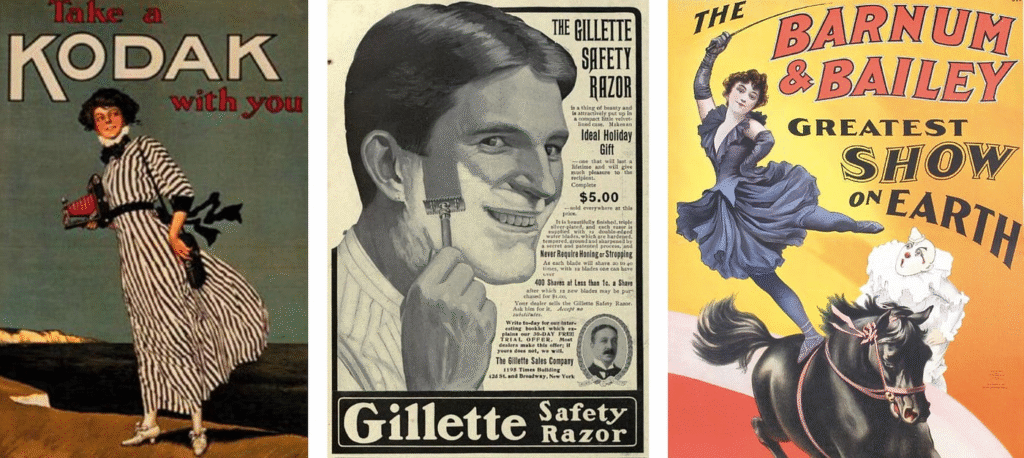
During the 18th and 19th centuries, mass production led to a surplus of goods and a pressing need to stimulate consumer demand. Print advertising, particularly in newspapers, flourished. As radio and later television emerged, businesses began investing heavily in persuasive mass media to influence consumer choices.
In 1937, the American Marketing Association (AMA) was established, helping formalize marketing as an academic discipline and emphasizing the importance of communication within the marketing mix. The field began to adopt theoretical frameworks, particularly as advertising grew more sophisticated.

Communication Theory and Message Transmission
A major turning point came in 1949 with Claude Shannon and Warren Weaver’s Mathematical Theory of Communication, originally created to explain how information travels across electrical systems. This model featuring a sender, message, channel, receiver, and feedback loop, was quickly adopted by communication scholars and later applied to marketing. It offered a systematic way to analyze how brands transmit messages to target audiences (Shannon & Weaver, 1949).
In the 1950s, Wilbur Schramm built on this model, emphasizing the importance of feedback, interpretation, and context in message reception (Schramm, 1954). These foundational ideas continue to influence marketing today, particularly in the era of digital media where consumer feedback is immediate and measurable.

Psychology, Consumer Behaviour, and Decision-Making
The mid-20th century also saw the rise of consumer behaviour research, drawing heavily from psychology and sociology. Herbert Simon’s concept of bounded rationality (1955) challenged the traditional economic view of the rational consumer, proposing instead that people make decisions based on limited information and cognitive shortcuts. This realization led marketers to incorporate emotional and subconscious appeals into their messaging.
Around this time, the AIDA model Attention, Interest, Desire, Action, gained traction. Although introduced by Elias St. Elmo Lewis in the late 1800s, it became widely adopted in advertising in the 20th century as a structured way to guide consumers through the decision-making process (Strong, 1925).

The Birth of Integrated Marketing Communications (IMC)
By the 1980s and 1990s, marketing communications had grown increasingly fragmented, with businesses using multiple vendors for advertising, PR, direct mail, and media buying. This often led to inconsistent messaging. In response, scholars like Don Schultz pioneered the concept of Integrated Marketing Communications (IMC), arguing that all communication channels should be aligned to deliver a unified message (Schultz, Tannenbaum & Lauterborn, 1993).
IMC shifted marketing communications from a tactical activity to a strategic function, prioritizing long-term brand equity over short-term campaigns. This holistic approach now underpins most modern marketing strategies.

Digital Media and the Participatory Consumer
The turn of the millennium brought a digital revolution. The internet, mobile technology, and social media drastically changed the nature of communication between brands and consumers. No longer passive recipients, consumers became active participants in the brand conversation.
Marketing communication began to emphasize engagement, personalization, and data-driven targeting. Concepts like permission marketing (Godin, 1999) and content marketing emerged, focusing on value creation and trust over traditional interruption-based methods.
Academic frameworks evolved, too. The Uses and Gratifications Theory, which examines why people actively seek out specific media to satisfy individual need, gained renewed relevance (Ruggiero, 2000). Marketers started tailoring content to consumer motivations, from entertainment and education to social connection and identity formation.
Final Thoughts
Marketing communications has evolved from simple trade announcements into a highly strategic, data-informed discipline that blends creativity, psychology, and technology. Its roots in ancient commerce, industrial advertising, communication theory, and consumer psychology reflect a long history of adaptation to social, economic, and technological change.
As we look to the future, facing new frontiers in AI, virtual reality, and ethical marketing, these foundational theories remain crucial. They remind us that while platforms may evolve, the human desire for connection, value, and meaning remains at the heart of all communication.
📚 Sources
Godin, S. (1999). Permission marketing: Turning strangers into friends and friends into customers. Simon & Schuster.
Jones, D. G. B., & Tadajewski, M. (2011). The history of marketing thought. SAGE Publications.
Ruggiero, T. E. (2000). Uses and gratifications theory in the 21st century. Mass Communication & Society, 3(1), 3–37. https://doi.org/10.1207/S15327825MCS0301_02
Schramm, W. (1954). The process and effects of mass communication. University of Illinois Press.
Schultz, D. E., Tannenbaum, S. I., & Lauterborn, R. F. (1993). Integrated marketing communications: Pulling it together & making it work. NTC Business Books.
Shannon, C. E., & Weaver, W. (1949). The mathematical theory of communication. University of Illinois Press.
Simon, H. A. (1955). A behavioral model of rational choice. The Quarterly Journal of Economics, 69(1), 99–118. https://doi.org/10.2307/1884852
Strong, E. K. (1925). The psychology of selling and advertising. McGraw-Hill.